
Payroll in trucking is not the same as payroll in a regular office job. While some operations pay drivers hourly, that’s not always the case. Drivers can be paid by the mile (empty, loaded, or total), by the load, based on percentages (x% for line haul, y% for accessorial, and don’t forget to allocate the revenue if the load was dropped and hooked). Sometimes there are bonuses, cash advances, or toll or lumper reimbursements. In addition, you have the standard payroll deductions and taxes.
When considering trucking payroll software, your main goal should be finding the ability to process payroll without losing your mind and without an accounting degree.
In This Article:
- Why “Regular” Payroll Software Falls Short in Trucking
- Driver Settlements: The Real Foundation of Trucking Payroll
- How Trucking Payroll Software Connects Everything Together
- Why Transparency Matters in Driver Pay
- Making Payroll Easier Without Oversimplifying It
- See How Payroll Works Inside Frontline Q7
- Payroll Set Up Makes All The Difference
- Is Trucking Payroll Software Easy to Use?
- Takeaway
Why “Regular” Payroll Software Falls Short in Trucking
Many trucking companies try to start with off-the-shelf general payroll software. Unfortunately, the assumption that any old payroll software will work out for trucking falls short in most cases.
Most standard payroll systems are designed around hourly employees or fixed salaries. They expect a simple input: how many hours someone worked during a pay period. The software multiplies that by a pay rate, calculates taxes, and generates a paycheck.
Trucking payroll rarely works that cleanly.
Driver pay is tied to the work they performed, and that work is tied directly to loads. One driver may haul three loads in a week, another may haul six shorter ones, and a third might run a long trip with detention time. Furthermore, the pay structure might also be different for each driver.
Trying to force all of those variables into a standard payroll system often leads to a patchwork solution. Companies start building spreadsheets, manually calculating pay formulas, and then entering the final numbers into payroll software after the fact.
This approach technically works! But it introduces two major risks.
First, manual calculations increase the chance of errors. Even a small mistake can create confusion or disputes with drivers. And on that note, super open-ended products like Excel can actually be a hindrance if you ever decide to move to a trucking software product.
Second, payroll becomes disconnected from the actual loads that generated the pay in the first place.
When payroll is disconnected from operations, accuracy becomes harder to maintain.
That’s why most trucking companies eventually realize that payroll needs to be calculated closer to the source of the work itself.
And that source is the load.
Driver Settlements: The Real Foundation of Trucking Payroll
Before a driver ever receives a paycheck, the company needs to determine what the driver actually earned. In trucking, this calculation happens in the form of a driver settlement.
A pay settlement is essentially a financial summary of a driver’s activity over a given period. It takes the loads that driver completed and calculates the earnings and deductions associated with them.
For example, a settlement might include revenue-based line haul pay from several loads, additional compensation for detention time, and adjustments for fuel advances or insurance deductions.
When everything is added together, the settlement shows the final amount owed to the driver.
In trucking, pay settlements calculate what drivers earn. Payroll is the act of getting those earnings and adjustments to the driver.
Understanding this relationship is key to understanding how trucking payroll software works.
Instead of starting with payroll and trying to reconstruct the numbers afterward, trucking software calculates driver pay directly from the operational data that already exists inside the system. That data includes loads, miles, revenue, and adjustments that have already been recorded during dispatch and billing.
How Trucking Payroll Software Connects Everything Together
Modern trucking payroll software bridges the gap between operations and accounting.
Key details about loads already exist as they are completed and billed. The system knows the miles involved, the revenue, the lane, and additional charges.
As drivers are assigned to loads, the software applies the driver’s pay formula. For one driver, the formula might be a percentage of the revenue. For another, it might be cents per mile plus extra compensation for certain activities.
Because the data already exists inside the system, most of the precise calculations happen automatically on the front end, before payroll even begins. This means you can calculate driver pay before the pay period is actually paid out.
In Frontline’s Q7 trucking software, for example, driver payroll is not handled as a completely separate process. Instead, payroll grows naturally out of the pay settlement process.
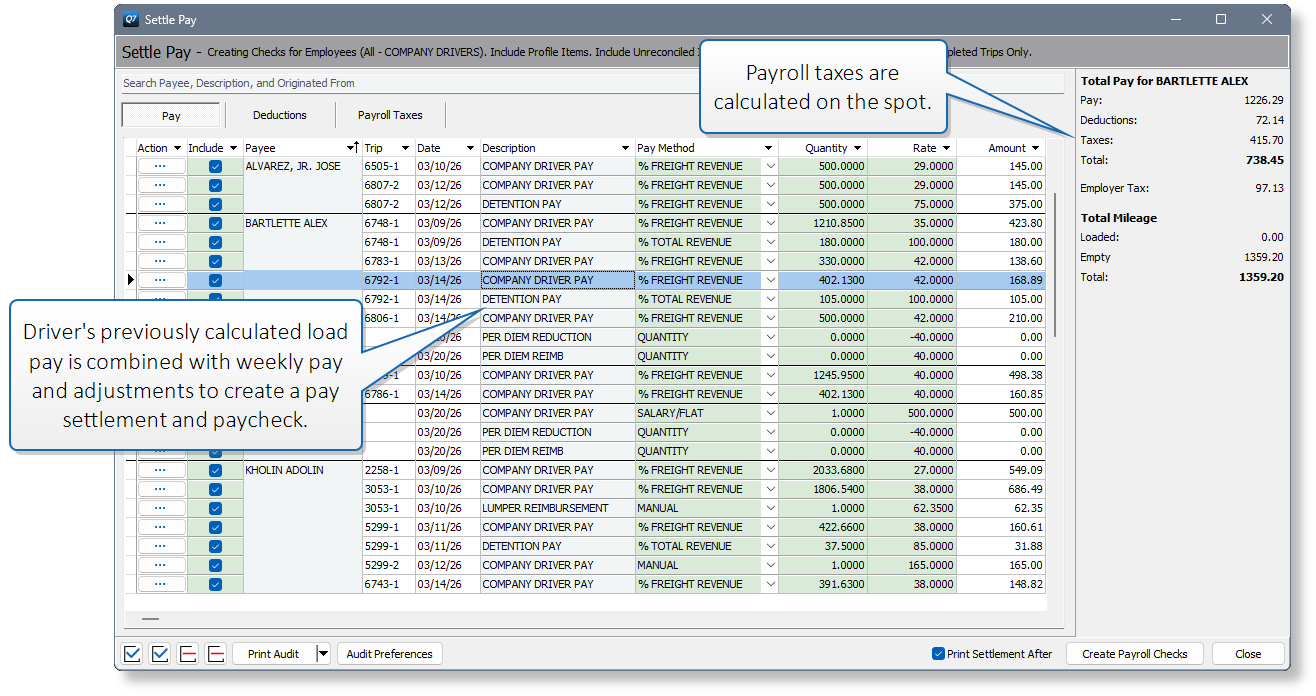
A pay settlement is produced based on real load data and shows clear deductions and adjustments. . Employee and employer payroll taxes are calculated on the fly. The heavy lifting has already been done, so as a result, this last step is actually easier.
The best trucking payroll software doesn’t guess what drivers earned. It calculates it from real load activity.
This approach helps eliminate many of the manual calculations and entries that cause errors or inconsistencies in traditional payroll software.
Why Transparency Matters in Driver Pay
Accuracy in trucking payroll isn’t only about bookkeeping. Maintaining trust with your drivers is also important for the health of your operation.
Drivers pay close attention to their pay settlements. They want to know that the miles match the loads they hauled and that any deductions or adjustments make sense. When payroll numbers appear out of nowhere without a clear explanation, it creates unnecessary tension between drivers and the office.
Settlement-based payroll systems make those conversations easier because the numbers can be traced directly back to the loads themselves.
When a driver asks how their pay was calculated, the office staff can use hyperlinks or other tools to provide backup to the pay settlement report. As a result, troubleshooting or explaining a question about a pay settlement is streamlined.
Transparency in pay settlements leads to confidence in payroll.
Transparency becomes increasingly valuable as a company grows and payroll calculations become more complex.
Making Payroll Easier Without Oversimplifying It
If payroll feels like it takes too much effort each week, the issue often isn’t payroll itself. In reality, it’s the process used to calculate driver pay.
One of the most effective improvements a trucking company can make is to move calculations closer to the operational data that already exists in the system.
Instead of calculating driver pay manually in spreadsheets, look for ways to standardize pay formulas and let the software apply them consistently. When settlements are produced from consistent and automatic calculations based on load specs, payroll becomes far more predictable.
This is where integrated trucking business software can make a major difference. The system handles much of the heavy lifting when dispatch, settlements, and payroll all share the same data.
The goal isn’t to make trucking payroll “simple”, because trucking operations are rarely simple. The goal is to make payroll consistent, reliable, and explainable.
See How Payroll Works Inside Frontline Q7
Trucking companies typically discover that payroll becomes simpler and more streamlined when it is connected to their operational data.
Frontline Q7 calculates company driver pay at the source: their loads. Pay profiles and other signals are set up to automate this task, with a staggering variety of pay methods and routine options. Load pay is merged with other pay and pay adjustments for the pay period in the Settlement dashboard. At this point in time, payroll taxes are a natural extension to the process. Payroll tax tables are built in to Q7, so employee and employer taxes are calculated on the gross wages.
Payroll isn’t limited to company drivers in Q7 trucking software. Include your office staff and salespersons, too.
Use professional and intuitive payroll reporting tools. The best part? With a simple report, you can connect your payroll expenses and load revenue all under one hood.
If you want to see how settlement-based payroll works, schedule a demo. We’ll show you how you can draw a line through dispatch, billing, and payroll.
Payroll Set Up Makes All The Difference
Trucking payroll software like Frontline Q7 has dozens of options for calculating driver line haul pay, accessorials, adjustments for drop & hook loads, etc. Set up is key.
Frontline Q7’s payroll set up focuses on the concept of a driver pay profile. These pay profiles instruct the system on how the driver should be paid, reimbursed, and deducted during operations or at the time payroll is processed.
Spend the time that it deserves to set up each driver’s pay profile for automatic calculation, and you save countless hours when it comes to processing payroll. A click of a button on a load calculates pay. That load pay is merged with pay-period adjustments, cash advance deductions, and payroll taxes to produce a final result.
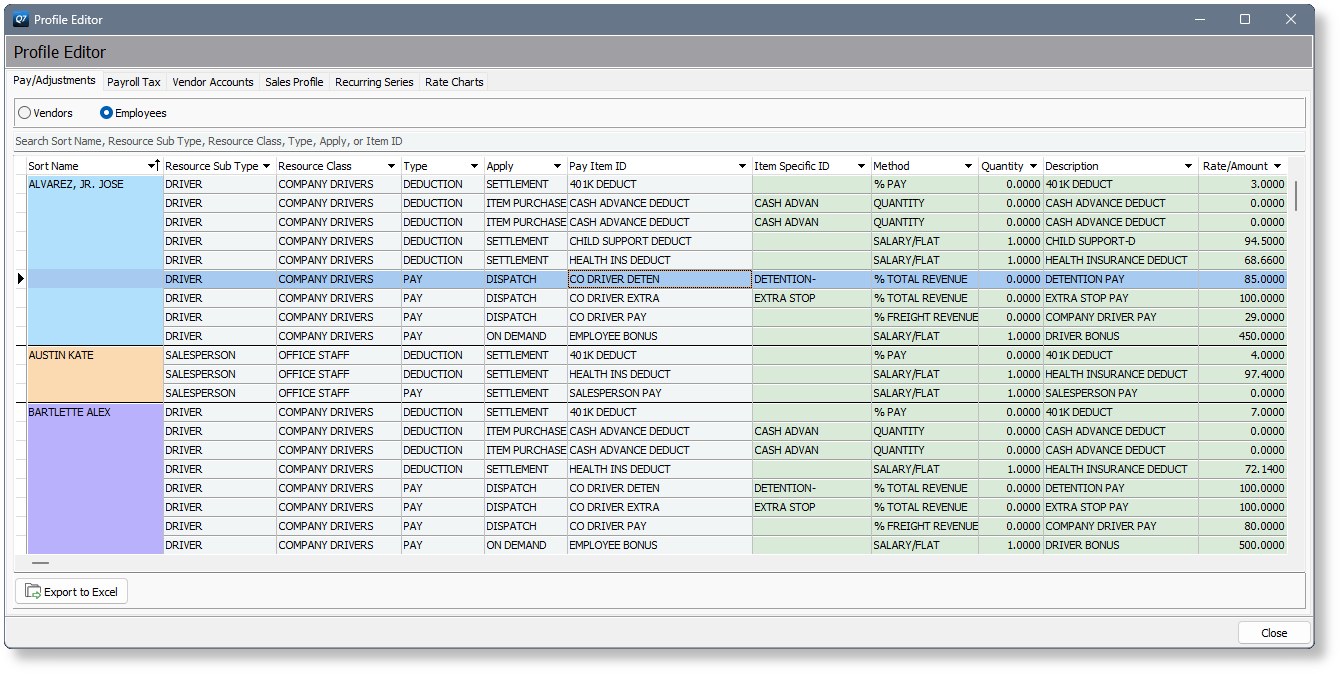
Use bonus features like Recurring Series to create a schedule for a specific pay or pay adjustment that should end after a specific dollar amount.
Copy or import pay profiles from one driver to another for a uniform and streamlined payroll operation. Each driver can still maintain their own rates or unique scenarios.
Is Trucking Payroll Software Easy to Use?
Experienced operators know that driver pay and payroll is rarely a “simple” topic. There are just so many variables involved, and those variables change from company to company and from year to year.
What good trucking payroll software can do is remove unnecessary complexity. It can automate calculations that were previously done by hand, reduce the chance of errors, and make settlements easier to review and understand. The inclusion of payroll taxes on the pay settlement makes the report even more transparent.
Over time, that consistency makes payroll feel far more manageable. Even… easy.
The goal of trucking payroll software is to attach payroll to the source of wages, and have a result that everyone understands.
When settlements and payroll are built into the same system, the process becomes smoother and far more dependable.
Takeaway
Payroll in trucking is closely tied to the work drivers perform, and that work is tied to loads. The companies that manage payroll most effectively are the ones that connect those pieces together instead of treating them as separate processes.
When settlements only need to be reviewed because the heavy lifting was done during day-to-day operations, the entire workflow becomes clearer and easier to manage. Once those dots are connected, payroll stops feeling less like a weekly chore and more like a reliable process.
Trucking Payroll Software: Frequently Asked Questions
What is trucking payroll software?
Trucking payroll software is software designed to calculate driver pay based on trucking-specific pay structures. For example, per mile rates, percentage(s) of load revenue, or flat-rate load pay. Unlike traditional payroll systems, trucking payroll software often connects directly to dispatch, load management, and driver settlements. As a result, driver pay is calculated automatically from completed work.
How do trucking companies calculate driver payroll?
Most trucking companies calculate at least the bulk of their driver pay at the load level. Whether that pay is mileage, revenue, or hourly based, it’s typical to produce a pay settlement for all drivers showing the work they did for the week. In this way, computed pay can sit right next to the load details. In addition to the load pay, pay period pay and adjustments (i.e., cash advances, health insurance and other benefits, etc.) are added to the pay settlement.
Payroll taxes are computed on the driver’s taxable wages. Payroll trucking software automates this by categorizing wages vs reimbursements vs deductions, which may or may not be tax exempt.
Why is trucking payroll different from regular payroll?
When it comes to the office staff, it’s not different at all. Where the difference lies is the driver pay. That’s because the drivers’ taxable wages are usually tied to loads and miles rather than hours worked or salary. Drivers can be paid per mile, by a percentage of load revenue, a flat rate per load, or even a combination.
Because these driver pay calculations depend on operational data, trucking payroll software like Frontline Q7 integrates with dispatch and accounting processes.
Can regular payroll software handle trucking payroll?
Regular payroll software can technically be used, but it usually means manual calculations before the data is entered. Many trucking companies end up using spreadsheets to calculate driver pay and produce pay settlements, then enter flat amounts and totals into payroll software afterward.
If you have a lighter weight dispatch software product, your driver pay may be calculated, but it’s being transferred to QuickBooks as flat amounts. Because of this, there is no link between the revenue and driver pay on the accounting level.
What is a driver settlement in trucking?
A driver settlement is a report that shows what a driver earned during a pay period. It includes load details, load revenue, mileage, earnings, bonuses, advances, deductions, and other adjustments.


